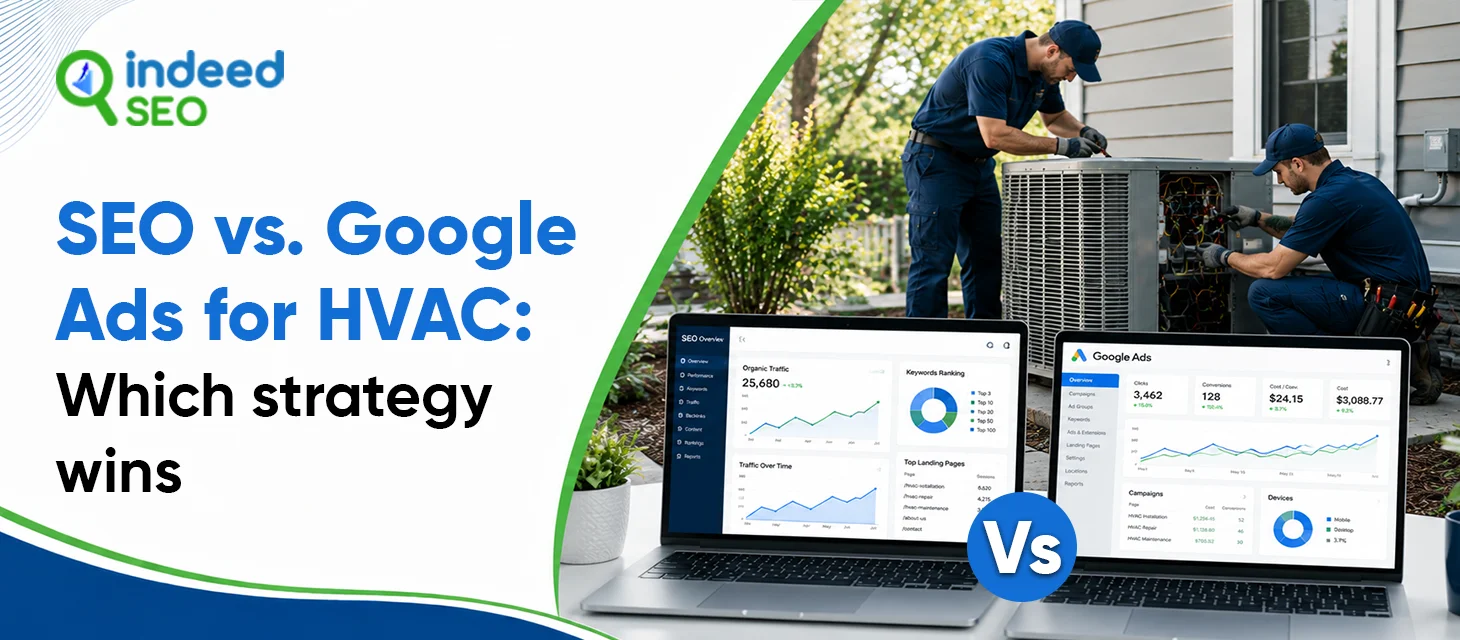
SEO and Google Ads are two of the most effective digital marketing strategies for HVAC industry. For HVAC companies, Google Ads wins for immediate emergency leads, while SEO wins for long-term profitability and sustainable growth. Contractors who combine both strategies generate 42% more total leads and achieve a 40% lower cost per acquisition than those relying on a single channel.
Increase Local HVAC Visibility and Drive More Bookings with IndeedSEO
What Is HVAC SEO?
HVAC SEO is the process of optimizing your business website to improve its search rankings. This helps you get found by your potential customers.Â
Examples include:
- HVAC contractor near me
- AC repair services
- Emergency HVAC repair services
- Furnace Installation Service provider
- Geyser repair company
SEO focuses on earning traffic naturally without paying for every website visit.
Key SEO Strategies
- Local SEO
- Google Business Profile optimization
- Technical SEO
- Keyword research
- Service page optimization
- Content marketing
- Link building
- Online review management
The primary goal here is to generate a consistent pipeline of organic leads over time.Â
What Is Google Ads for HVAC?
Google Ads for HVAC refers to leveraging PPC advertising platforms to place your business website on top of the search results. You pay only when someone clicks on your ad.Â
Google Ads generate leads almost immediately after you launch a campaign.Â
Google Ads Includes
- Search Ads
- Local Services Ads (where available)
- Display Ads
- Remarketing campaigns
- Call-only ads
- Performance Max campaigns
This makes PPC ideal for businesses that need immediate visibility.
SEO vs. Google Ads: Side-by-Side Comparison
| Feature | SEO | Google Ads |
|---|---|---|
| Time to Results | 3 to 6 months | Immediate |
| Cost Per Click | No | Yes |
| Long-Term Value | Excellent | Stops when ads stop |
| Trust & Credibility | High | Moderate |
| Lead Generation Speed | Gradual | Fast |
| Local Visibility | Excellent | Excellent |
| Budget Flexibility | Medium | High |
| Best For | Sustainable growth | Immediate leads |
When Should HVAC Companies Choose SEO?
For HVAC businesses looking for long-term business scalability, SEO is a better option.Â
SEO is ideal for businesses looking for:
- Long-term online visibility
- Lower dependency on paid ads
- Better local search rankingsÂ
- Generate consistent leads
- Improve brand authority
Although SEO takes time, it delivers better cost per lead over time.Â
When Should HVAC Companies Choose Google Ads?
Google Ads is an ideal choice for your HVAC business when you need quick leads.Â
PPC works well for:
- New HVAC businesses
- Peak season promotions
- Urgent repair servicesÂ
- New service areas
- Competitive ad visibility in the local market
With PPC advertising, you can attract appointment bookings and phone calls within days of launching your ads.Â
SEO vs. Google Ads- Which Strategy Delivers Better ROI?
The right answer depends on your objectives
Choose SEO for better long-term ROI
With effective SEO strategies, you can rank your website. And once your website ranks, you can generate organic traffic without paying for every click. Although SEO is an ongoing process, the returns often compound with time.Â
Pick Google Ads to Get Faster ROI
Google Ads offer immediate visibility and measurable results. Thus, making it an excellent choice for businesses that need instant visitors.Â
Why Many HVAC Companies Use Both
Many successful HVAC businesses combine both SEO and Google Ads instead of choosing one.Â
But why do they combine both strategies?
Because:
- It generates leadsÂ
- Brings long-term organic traffic
- Enhances overall search visibilityÂ
- Turns visitors into clients
- Test keywords before targeting them
With both SEO and Google Ads, HVAC businesses build a long-term marketing strategy.Â
Common Mistakes HVAC Businesses Make
Prioritizing Paid Advertising Only
Paid ads usually work until campaigns persist.Â
Ignoring Local SEO
Usually, HVAC customers search for nearby services. Hence, optimizing your Google Business Profile is essential.Â
Poor Landing Pages
A poorly optimized landing page can significantly impact your conversion rates.Â
Failing to Track Performance
It’s critical to monitor the following key metrics:
- Website traffic
- Phone calls
- Form submissions
- Cost per lead
- Conversion rate
- Return on ad spend (ROAS)
Making data-driven decisions leads to informed marketing outcomes.Â
Expert Tips for HVAC Marketing Success
- Focus on local keywords
- Optimize every landing page
- Encourage your clients to leave Google reviews
- Strategize Google Ads during peak business seasons (summer and winter)
- Keep track of every source
- Monitor your ad campaign conversions
Why Choose IndeedSEO for HVAC SEO and Google Ads?
IndeedSEO is a top choice to generate immediate leads for your business. The experts here are equipped with result-driven strategies that are tailored to your HVAC business goals.Â
With IndeedSEO, you maximize your visibility across your immediate region to attract the right audience. Get the best combination of SEO and Google Ads that scales your traffic and builds long-term authority.Â
What IndeedSEO Offers
- Google Business Profile optimization
- Technical website SEO
- Call tracking and conversion tracking
- Monthly performance reporting
- Continuous campaign optimization
- Competitor analysisÂ
- Customized ad campaigns
- Emphasis on local SEO
- Landing page optimizationÂ
Increase Local HVAC Visibility and Drive More Bookings with IndeedSEO
Last Thoughts
Still confused about which strategy wins between SEO vs.Google Ads for HVAC? IndeedSEO offers the right combination tailored to your HVAC business goals. Reach out to book a free consultation today!
PakarPBN
A Private Blog Network (PBN) is a collection of websites that are controlled by a single individual or organization and used primarily to build backlinks to a “money site� in order to influence its ranking in search engines such as Google. The core idea behind a PBN is based on the importance of backlinks in Google’s ranking algorithm. Since Google views backlinks as signals of authority and trust, some website owners attempt to artificially create these signals through a controlled network of sites.
In a typical PBN setup, the owner acquires expired or aged domains that already have existing authority, backlinks, and history. These domains are rebuilt with new content and hosted separately, often using different IP addresses, hosting providers, themes, and ownership details to make them appear unrelated. Within the content published on these sites, links are strategically placed that point to the main website the owner wants to rank higher. By doing this, the owner attempts to pass link equity (also known as “link juice�) from the PBN sites to the target website.
The purpose of a PBN is to give the impression that the target website is naturally earning links from multiple independent sources. If done effectively, this can temporarily improve keyword rankings, increase organic visibility, and drive more traffic from search results.
